

“How much budget should I invest in Google Ads and what results should I expect?” – This is probably the first question that pops in your mind before launching your first Google Ads campaign, and it is a valid one. Today, we will explain how to estimate Google Ads budget for new campaigns.
If you have run campaigns in the past, you can refer to your historical data to see what kind of performance you can expect. Nonetheless, search demand always changes, so it’s crucial to check your current assumptions by monitoring the newest search trends and the competitiveness of the Google auction.
For argument’s sake, let’s assume you’ve never run search ads before, and you want to know how much of your advertising budget it will consume. Keyword Planner is a tool that helps advertisers check search volumes, estimate CPC, and suggest some keyword ideas to help you increase relevant traffic. It’s quite a powerful tool and better prepares advertisers for running successful search campaigns.
There are just a few simple steps for estimating your initial budget and reach in Google Ads using Keyword Planner.
-
Select a couple of keywords that best describe your business or product
Start by mapping some keywords that accurately describe what you do or what you offer. This list will be your reference or base, which you will use for further keywords analysis later.
To access Keyword Planner you need to complete the account setup and your account has to be set to “expert mode”. To access this setting, navigate to “TOOLS & SETTINGS”, where you can find this tool under the “PLANNING” section.
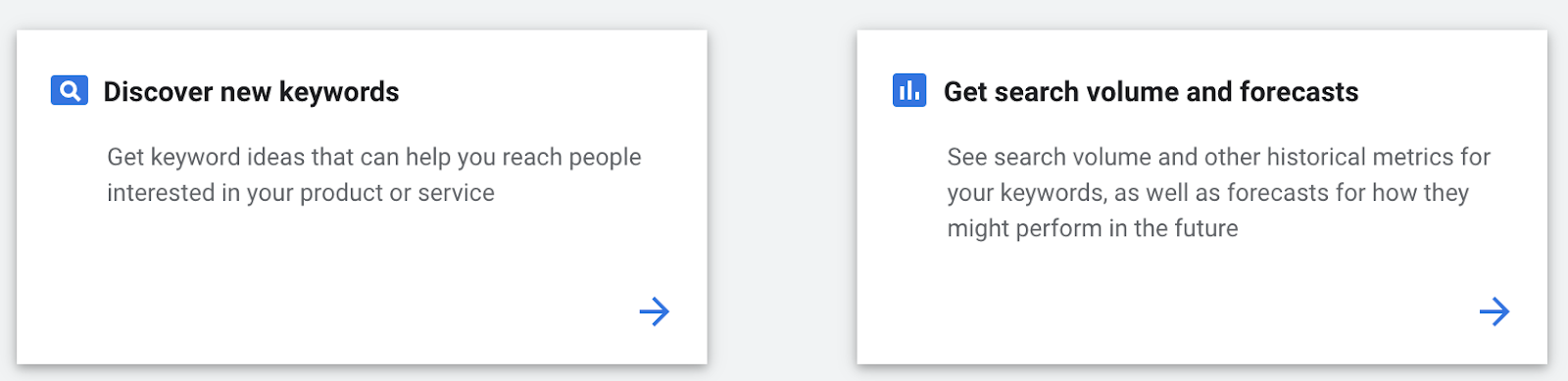
The tool will give you a chance to choose one of two options: you can either get keyword ideas to help you increase your reach or check the current search volumes and see the forecast for selected keywords.
-
Discover new keywords
The first approach to estimate the budget is a bit more manual and requires some data manipulation.
Keyword Planner shows advertisers search volumes for selected keywords and also suggests some alternatives, which can be helpful for making your keyword portfolio either more granular or comprehensive. The Average monthly searches metric and seasonality data show you how popular a given keyword is in different months. This is an extremely valuable insight, as it will suggest how your search campaigns can be developed throughout the year. Alongside this data, there are other essential metrics called Top of page bid (low range) and Top of page bid (high range), which give an approximation of the 20th (low range) and 80th percentile (high range) that advertisers have historically paid for a keyword’s top-of-page-bid.
Although this data is only a rough estimate of how expensive the auction is, it can give you some understanding of what your maximum and minimum CPC will be. To estimate your budget, you can pull the keyword data into an Excel sheet and build different models that take into account Search Impression Share (SIS) and Click-Through-Rate (CTR). By manipulating data in this way, you can roughly estimate your expected minimum and maximum spend for keywords with a certain search demand.
-
Check search volume and forecast data.
This option is a quicker method for getting an idea of what you might spend on Google Ads and the results you can expect.
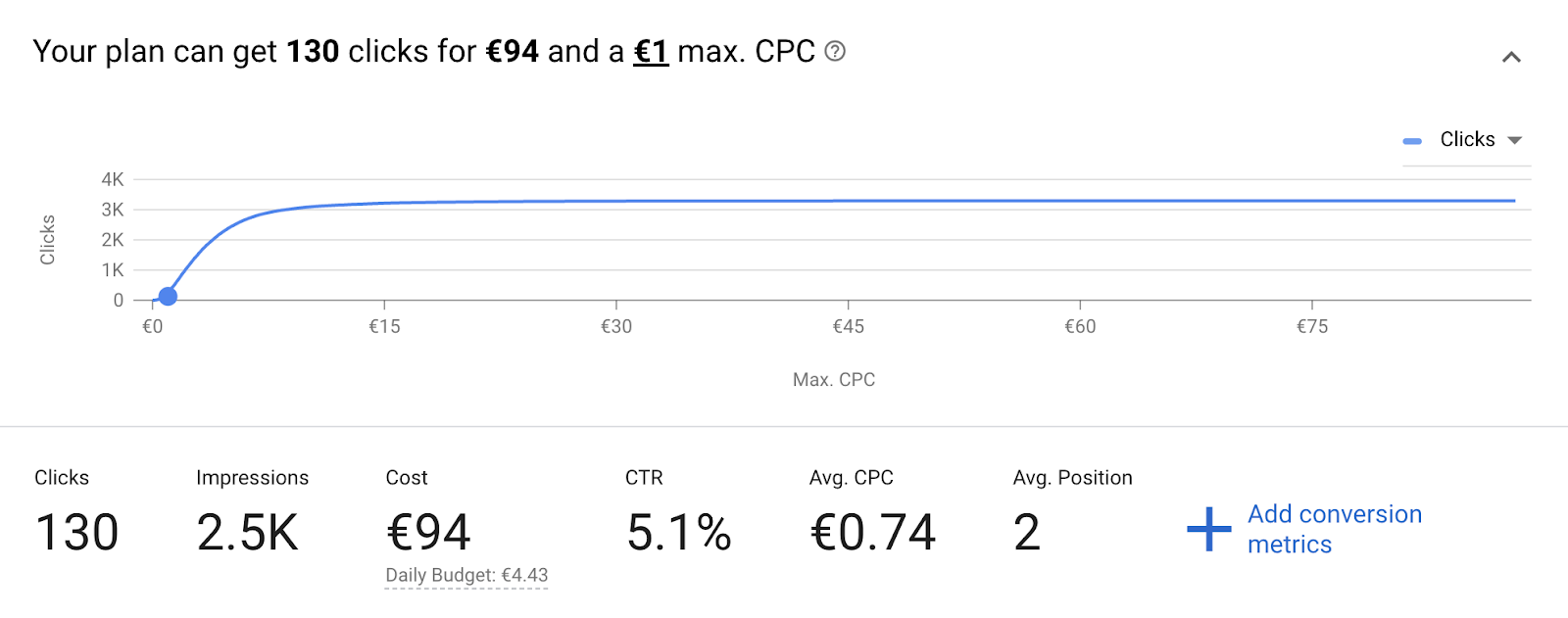
After providing a set of keywords that best define your product or service, you can see the forecast of your performance in table and graph format. Google uses algorithmic modeling to estimate future performance, and its forecasts take seasonality into account and adjust for market fluctuations.
An example of the forecast you can get for selected keywords:
Conclusion
Although there is no magic formula that tells you exactly what your Google Ads budget should be, with Keyword Planner, you can get a pretty good idea of what it will look like. When planning your future spending on Google, remember to consider various factors, such as the complexity of your keyword portfolio, the competitiveness of the search auction (which affects the CPC), and the seasonal trends affecting the demand.
If you want to start your advertising adventure with Google Ads and need a hand estimating the budget for your first campaign, just contact us – we will be happy to help!
